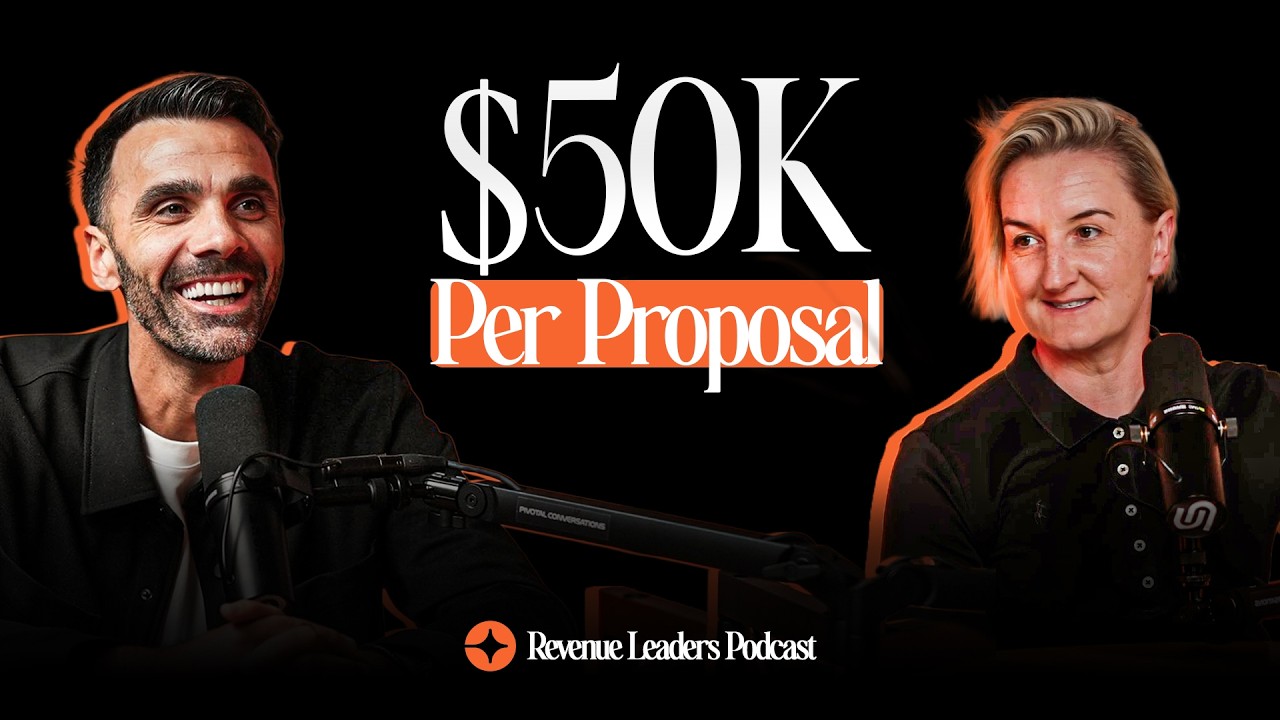
Proposals cost about $50,000 of internal time, and most skip the problem statement. Problem, current state, future state, path, investment. In that order.
Key takeaways
If you can’t write the problem statement clearly, you can’t write the proposal. Go back a step in the sales process rather than papering over the gap.
Proposals get shared. Deal-room analytics show four to nine readers on a typical document, so write role-relevant sections for the technology lead, risk, and finance.
Readers go to page one and the investment page first, then selectively back. The executive summary has to carry the reason to act on its own.
Include the action plan and the road map beyond signature. Buyers need to see resourcing, sequencing, and internal asks before they can say yes.
Regan Barker’s win rate on proposals this financial year is 100 percent, and she’d rather it wasn’t, because it means she’s not on enough deals.
If page one opens with “about us,” you’ve already failed the coffee test.
Out of those five proposals, not one actually had a clearly articulated problem statement. They didn’t actually have a reason for the proposal being submitted in the first place.
Luigi Prestinenzi, co-founder, Ricavi
Visualise the CEO sitting down with a cup of coffee, putting it in front of them, and turning the page. And every page they turn, thinking: why would I ever leave?
Regan Barker, co-founder, Ricavi
What does a proposal actually cost?
More than the time to write it. By proposal stage you’ve had several meetings, shared a discovery brief, aligned internally, and built the document. Luigi Prestinenzi’s point is that this is where a deal starts costing money rather than minutes. Regan Barker’s former employer, a major bank, calculated a minimum of $50,000 in internal time per institutional proposal. At that price, sending one that talks about yourself is an expensive way to lose.
What’s missing from most of them?
The buyer. Luigi evaluated five for a client and found no problem statement, no current or future state, and no commercial benefit in any of them. Page one was “about us.” Regan’s read is that vendors write about themselves because it’s comfortable, and treat the proposal as a task to complete rather than a deal to win. The last buyer-centred proposal she remembers receiving was Luigi’s, five or six years ago, when he first pitched her firm.
The structure she teaches is short. Problem statement, written so clearly it proves you understood. Current state: this is what we heard. Future state: this is where you want to be. Then how you get them there, and the investment. Her visual test is the chief executive with a coffee, turning pages, and every page answering the question of why they’d ever leave.
Who is the proposal really for?
The committee. Deal rooms show documents shared across four, five, nine people, and each reads for something different. The person implementing the software wants one thing. Risk and legal want another. Finance goes straight to the investment page, and Regan has the data to prove that page one and the pricing page get read first. So the executive summary has to carry the whole argument, and the sections beneath it have to be findable by role. Then add the action plan. A proposal is a project the buyer is about to resource, and they need to see what’s asked of them after signature as clearly as what’s asked before.
Questions this episode answers
What should a B2B proposal contain?
Problem statement, current state, future state, the path between them, and the investment, in that order. Anything about the vendor comes after the buyer’s story, not before it.
How much does it cost to respond to a proposal?
At institutional level, around $50,000 of internal time by one bank’s calculation cited on the episode. That’s why qualification before proposal matters so much.
Which part of a proposal do buyers read first?
The first page and the investment page, based on deal-room analytics the hosts describe. Everything else gets read selectively, so the executive summary has to make the case alone.
Share article
Turn meetings
into revenue.
Coach every rep, capture every call, and know exactly what's going to close.
We offer hands on onboarding
“Ricavi is the AI sales platform that coaches your team in real time. Our customers see 7.8x pipeline growth in under 90 days.”

David Fastuca
CEO & Co-Founder
