For the person who owns the number
Sales forecasting software that runs your pipeline review on evidence.
Your reps tell you what they’ll close. Ricavi reads their calls and your CRM, and puts its own number next to theirs. Start the review where the two don’t match.
Ricavi’s forecast sits next to yours once ten or more deals have closed.
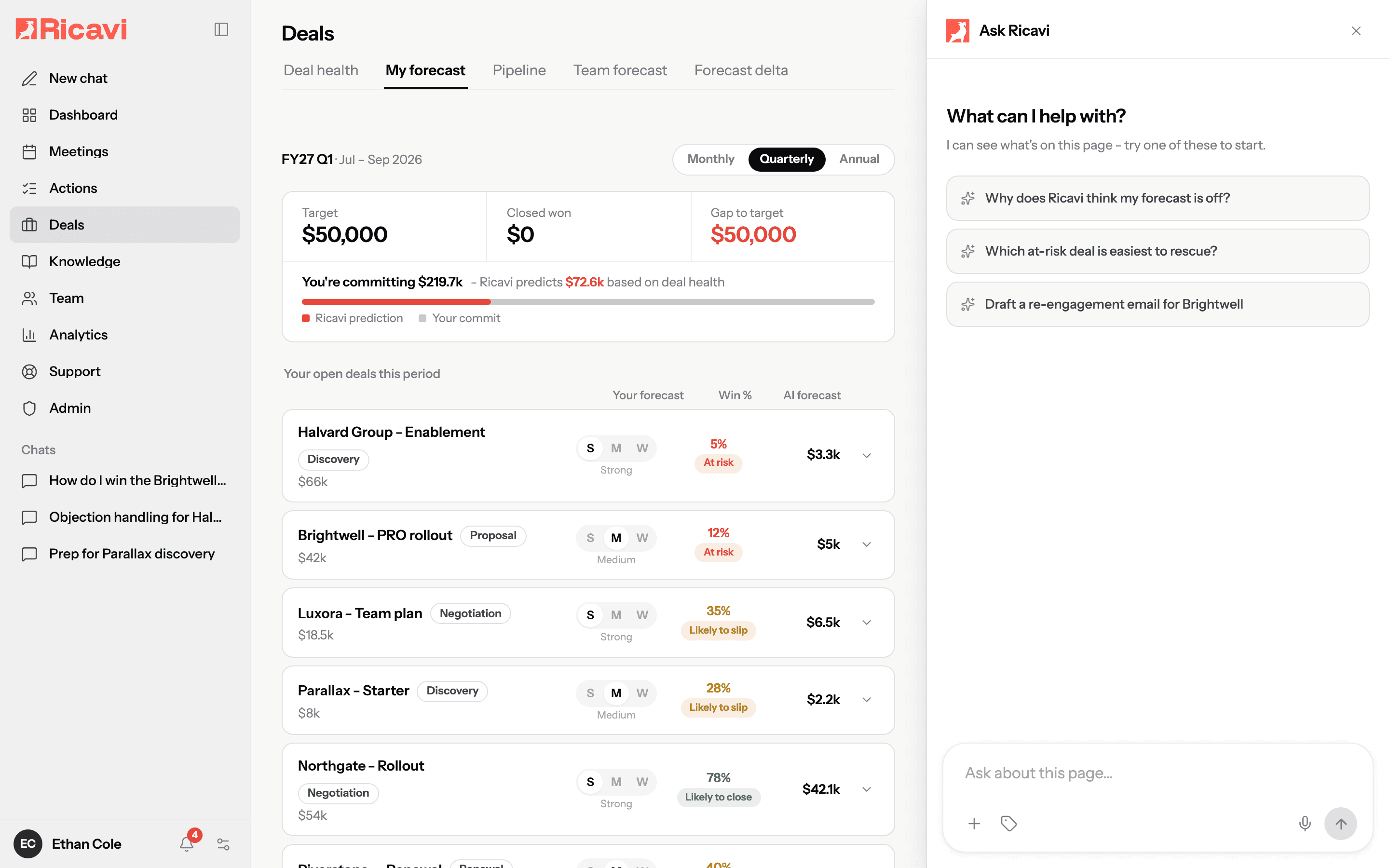




What Ricavi does for your forecast.
Two numbers
Ricavi puts its own number next to each rep’s, deal by deal.
Each deal checked
Each deal shows its chance to close, and the evidence behind it.
Where the gap sits
See who the gap sits with, and why.
Next moves drafted
Ricavi drafts the email, task, or stage change for the rep to approve.
Where Ricavi sits
Forecasts from the CRM and call tools you already use.
Calls come in from Google Meet, Microsoft Teams, and Zoom. Ricavi reads the deals in your CRM and scores each one from what buyers said. It drafts updates for the rep to approve.
83%
Less admin
Ricavi writes the call notes, drafts the follow-ups, and updates the CRM once reps approve.
The stack: calls on Google Meet, Microsoft Teams, and Zoom feed Ricavi. Ricavi sits above your CRM (HubSpot, Salesforce, Microsoft Dynamics): account, deal, and contacts come up, drafted updates go down once the rep approves them. Google Calendar, Outlook, Google Drive, and OneDrive sit alongside.
 Google Meet
 Microsoft Teams
 Zoom
 Google Calendar
 Outlook
So the pre-call brief lands 30 minutes before each call.

Reads the deals in your CRM and scores their health.
- Price objection
- Decision process still open
- Scorecard, 62/100
Calendar
 Files
- Google Drive
- OneDrive
Connected at onboarding, with your calendar.
 HubSpot
 Salesforce
 Microsoft Dynamics



Not a DIY product. Installed and monitored by sales and technical leaders.
Same deals, two numbers.
Your commit
A commit is what a rep says will close this quarter. The rep calls these deals Strong or Medium.
What Ricavi says
Ricavi scores each deal’s health from what buyers said on calls and what’s in your CRM. Each deal shows its chance to close.
Where they split
The rep called Luxora Strong. Ricavi gives it a 35% chance and marks it likely to slip.
“
Ricavi has helped me generate 50% more net new opportunities. Over an 11-week period, I was able to secure 12 new deals, resulting in a 38% increase in our quarterly sales.

Conor Bell
Account Executive, HubSpot
Pipeline management software
Trace one deal back to the evidence.
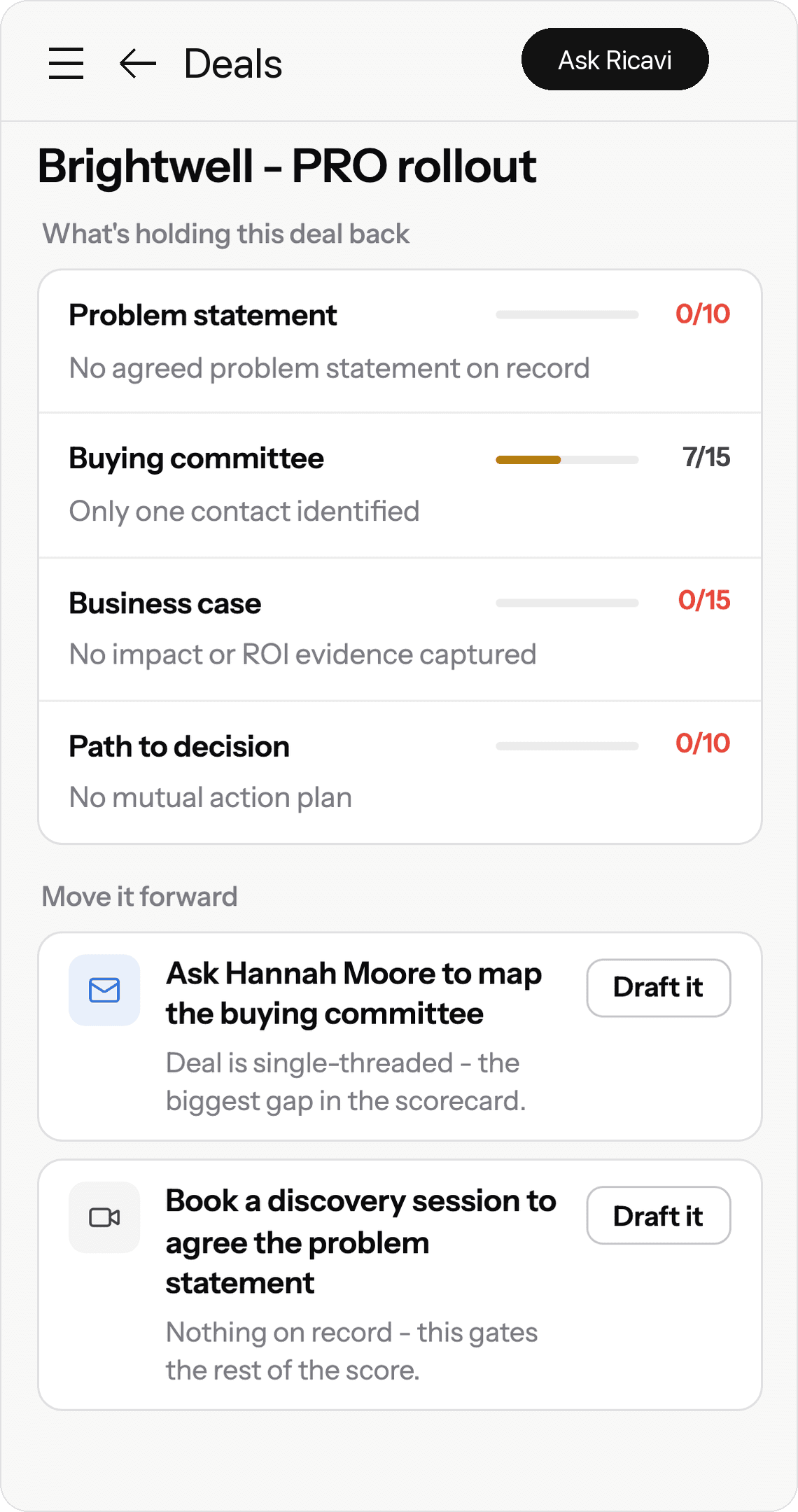
Brightwell is one of this rep’s deals. The rep called it Medium, but Ricavi gives it a 12% chance to close. Here’s why.

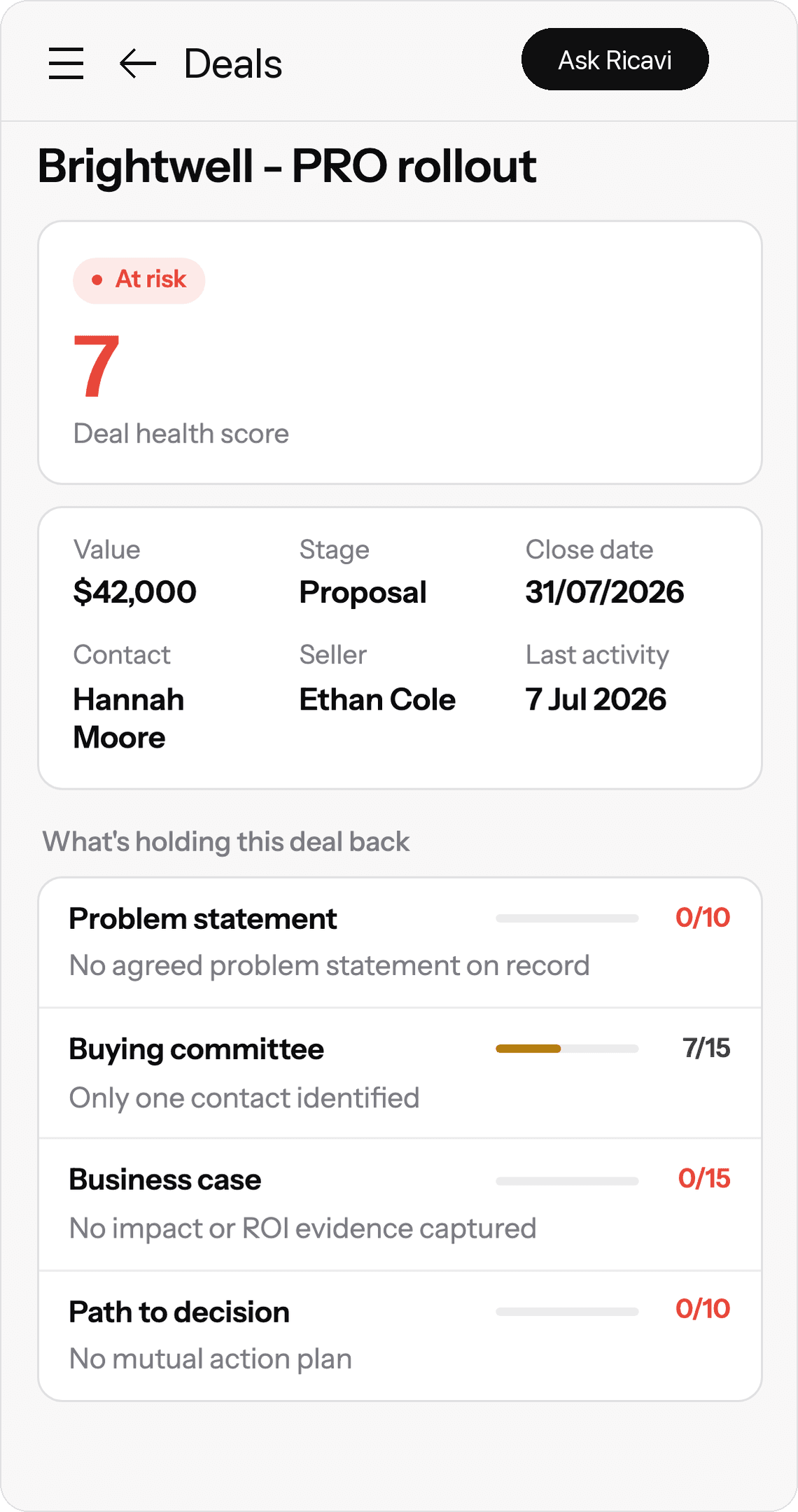
What the CRM counts
$42,000 at Proposal, close date 31 July.
The CRM counts the stage and close date the rep typed in. Nothing here says what the buyer agreed to.
What’s missing
Four gaps, each named.
Deal health finds only one contact, and nothing agreed on the problem, the business case, or how they’ll decide. That’s why Ricavi says 12%.
The next move
The ask that closes the biggest gap.
Ricavi drafts the next move: ask Hannah Moore who else is buying. Deal health goes up as each gap is filled.
The CRM counts the stage. Ricavi reads what buyers said.
How teams forecast
Sales forecasting techniques, and where each one breaks.
Most teams forecast from the rep’s word, the deal’s stage, or last quarter’s results. Each one misses something. Ricavi checks every deal against what buyers said.
3.2x
More accurate forecasts
Deals are scored on what really happened on the call.

- Yes
- No
What the rep says
Yes: Ricavi puts its own number next to each rep’s, deal by deal.
Yes: Each rep calls their own deals: commit, best case, or out.
Yes: Each stage has a set win chance, times the deal value.
Yes: Last period’s results and win rates, carried forward.
Which deals are real
Yes: Each deal gets a chance to close from what buyers said. The gap shows you where to look.
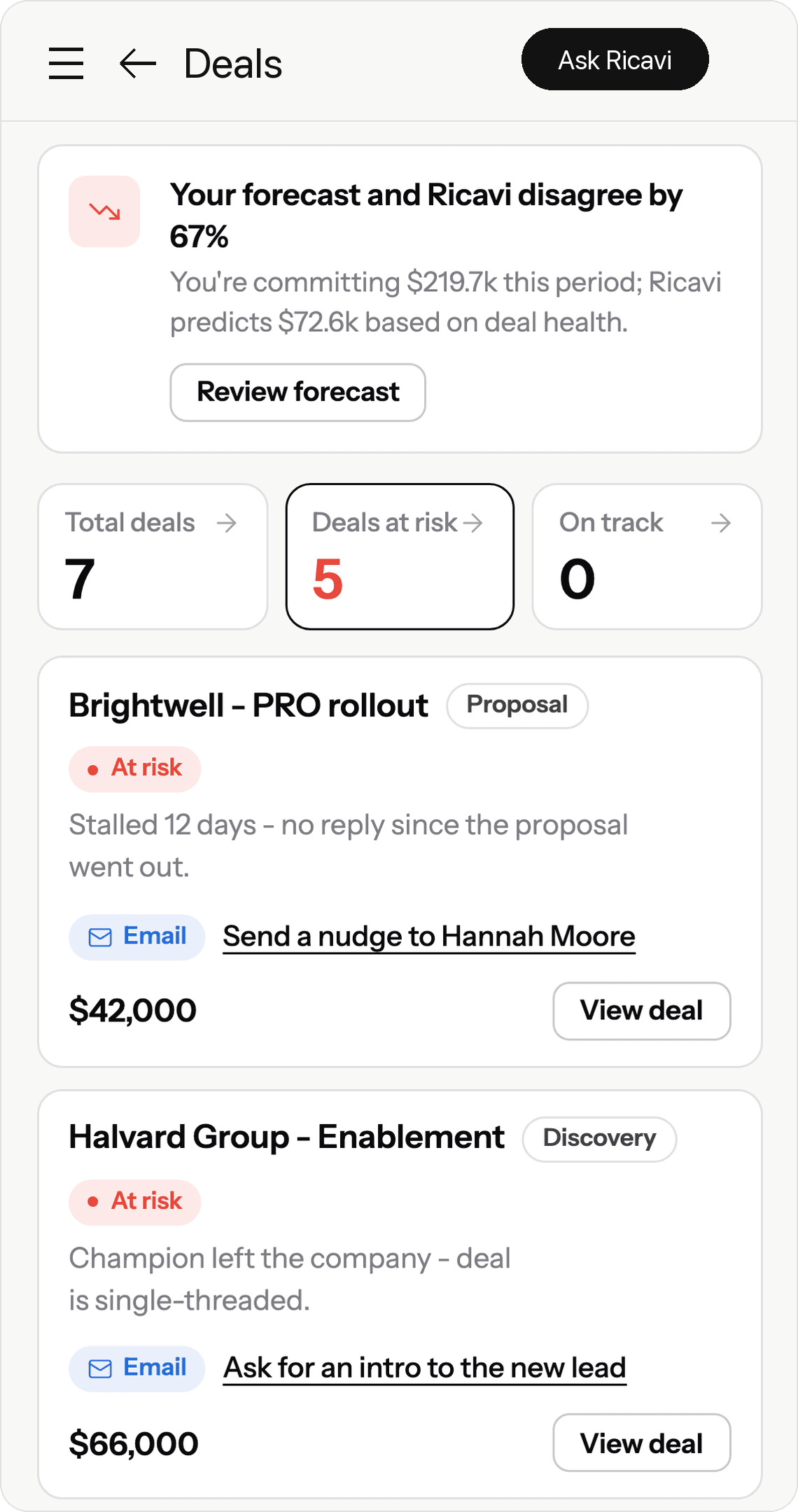
No: Hopes and fears creep in, and nobody can check why.
No: The rep picks the stage. A deal can sit at Proposal before discovery is done.
No: It assumes this quarter looks like last quarter.
What’s missing
Yes: Each deal shows what the buyer hasn’t agreed to yet.
No: The stage says nothing about what the buyer agreed to.
What to do next
Yes: Ricavi drafts the email, task, or stage change for the rep to approve.
No: No next move for any deal.
The team view
Your reps say $4M. The calls say $2.6M.
This is Ricavi’s team view. Each rep’s number sits next to Ricavi’s, so you can see who the $1.4M gap sits with, and why.
Your reps say $4M.
Rep-submitted is your reps’ commit this quarter. From one example team.
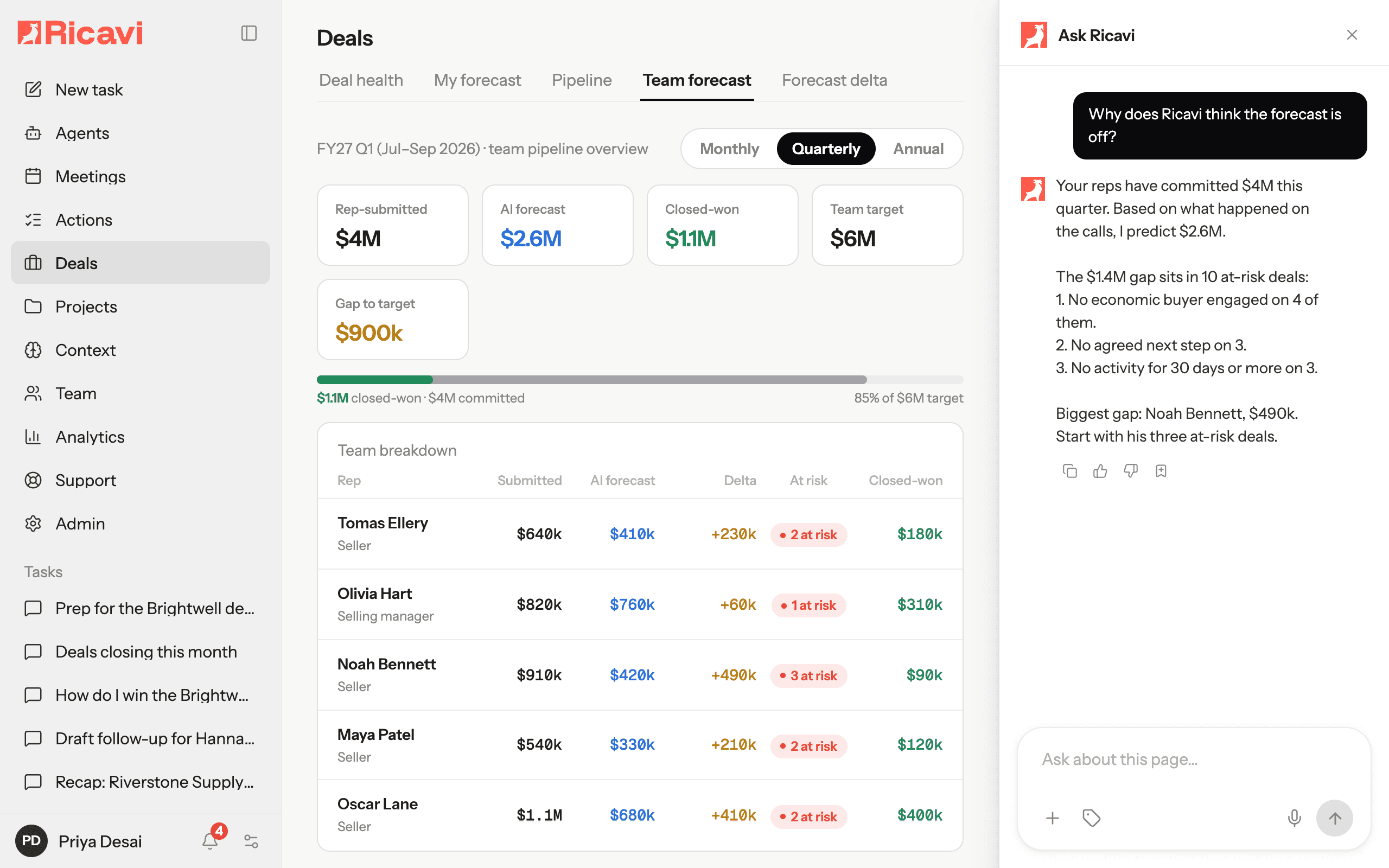
Five reps, ten at-risk deals.
The $1.4M gap sits in 10 at-risk deals.
Start with Noah Bennett.
Biggest gap: Noah Bennett, $490k. Start with his three at-risk deals.
| Rep | Delta | At risk |
|---|---|---|
| Noah Bennett | +$490k | 3 at risk |
| Oscar Lane | +$410k | 2 at risk |
| Tomas Ellery | +$230k | 2 at risk |
| Maya Patel | +$210k | 2 at risk |
| Olivia Hart | +$60k | 1 at risk |
| Rep-submitted | $4M | |
| AI forecast | $2.6M | |
The gap isn’t spread evenly. A few reps carry most of it.
Step by step
How to run a pipeline review on the evidence.
A pipeline review is the meeting where you go through the deals behind the forecast. Start with the gap between each rep’s number and Ricavi’s. Open the deals where they differ most. See what’s missing, and agree the next move. Then you can explain the number you take upstairs.
- Before the review
Each rep has entered a commit: the deals they say will close.
Ricavi puts its own forecast next to each rep’s, from deal health.
- First
Not every deal needs the same time.
Start with the rep whose number is furthest from Ricavi’s.
- Each big gap
The rep says a deal will close. Ricavi gives it a low chance.
Each deal shows its chance to close, and the evidence behind it.
- On each deal
A deal sits at Proposal, but the buyer hasn’t agreed to much.
Ricavi shows what the buyer hasn’t agreed to yet.
- Before you leave
Every deal you opened needs a next move.
Ricavi drafts the email, task, or stage change for the rep to approve.
- After the review
Finance asks how sure you are.
You can show the evidence behind each deal in the number you take upstairs.
Last reviewed 20 Oct 2026 · Source: Ricavi product documentation
Start where the numbers differ most. Then agree the next move.
“
“I was at dinner and overheard my team telling our GM how valuable they found Ricavi.”

Jane Susak
Sales Manager, Essential Assessment
Meet us before you buy. Watch, read, or join.

Revenue Leaders podcast
Hosted by Luigi, Regan, and Dave
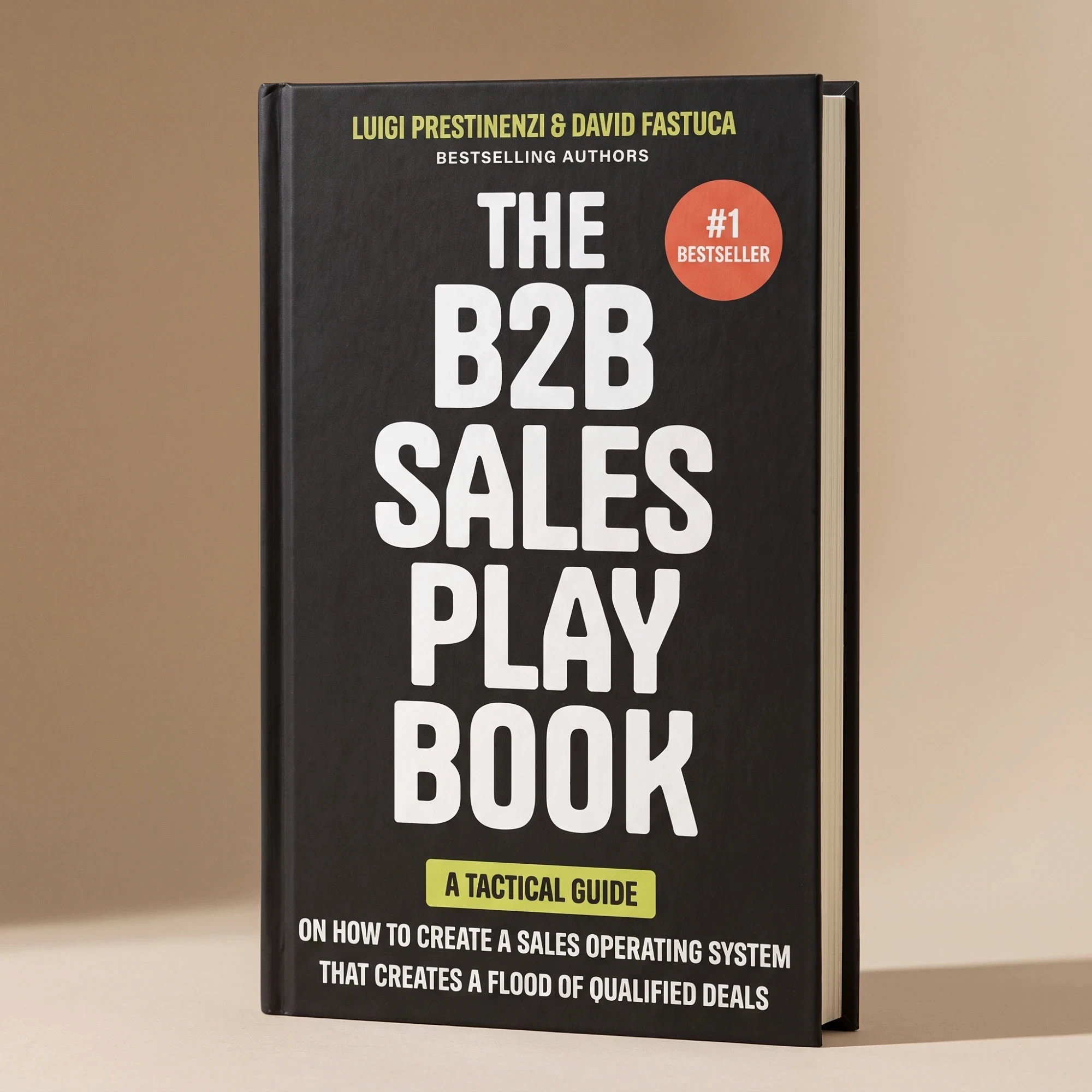
The B2B Sales Playbook
By Luigi and Dave

The live weekly session
Free, in Growth Forum
Under the bonnet
Built on how sales is taught, not bolted on.
Behind Ricavi are 20 years of the founders’ sales coaching and 5,000+ built-in skills.
The people behind it
Built by builders.
Dave builds companies. Regan builds sales teams. Luigi builds performance.
Built-in skills
5,000+
Each one is a play for one moment in a deal, like spotting which deals need you this week or mapping the buying committee.
“I have been working with the team at Ricavi for the last two months and already achieved higher conversion rates and a faster sales cycle.”

Stuart Cook
MD, TWIYO
If you remember one thing
The five things on this page.
1
Your rep’s number and Ricavi’s, side by side.
2
The CRM counts the stage. Ricavi reads what buyers said.
3
Each way to forecast has a blind spot. Ricavi checks the calls.
4
The gap isn’t spread evenly. A few reps carry most of it.
5
Start where the numbers differ most. Then agree the next move.
Sales forecasting software predicts how much your team will close in a period. A CRM forecast adds up the stages and close dates reps enter. Ricavi forecasts each deal from deal health, a health score based on what buyers actually said on calls and what’s in the CRM. Each rep’s own call sits beside it.
Sales forecasting software that runs your pipeline review on evidence.
Your reps tell you what they’ll close. Ricavi reads their calls and your CRM, and puts its own number next to theirs. Start the review where the two don’t match.
Ricavi’s forecast sits next to yours once ten or more deals have closed.